January 24th, 2012 at 12:37 pm
Built-up Roof Blisters
Flat Roofing Repairs – Built-up Roofing Membrane
Blisters may need to be repaired if
- The blisters occur in areas of high traffic
- Membrane deterioration
- Excessive loss of surfacing (gravel)
- Blisters in laps which have reduced lap coverage
- Blisters have breaks, or cracking
Whether to remove, patch, or monitor blisters is a judgment call. Blisters that are keeping air in will keep water out, if this is the case it may be preferable to leave the blisters undisturbed. Should it be determined that blister removal is necessary, the following steps should be used.
- Remove all loose debris from the surface of the membrane or flashing to be repaired. The area should extend a minimum of 18 inches beyond the perimeter of the defect.
- If membrane surface has been flood coated and aggregate embedded, carefully spud the aggregate free from the surface and sweep clean.
- Carefully cut and remove the blistered material until good adhesion of the membrane is reached.
- Inspect insulation or deck for damage caused by water infiltration. Remove wet or damaged insulation and repair or replace as required. Properly attach or adhere new, dry insulation (consistent with the thickness of the existing insulation).
- Prime the surface of the BUR membrane with asphalt primer. Be sure not to overuse the primer, because it may harm the existing membrane and inhibit adhesion of newly applied membrane.
- Install the same number of plies as were removed in cold-applied adhesive or hot bitumen. Extend the bottom ply at least 6 inches beyond the area to be repaired and each exceeding ply at least three inches beyond the previous ply.
- Reapply the surfacing. For small repair areas, it is a common practice to apply the coating immediately after the membrane repair is made.
Tags:
built up roof,
roof blisters,
roof patch
November 1st, 2011 at 7:44 am
Many Leaks are Caused by Mechanical Rooftop Equipment
Who’s to Blame? Don’t Blame the Roofer
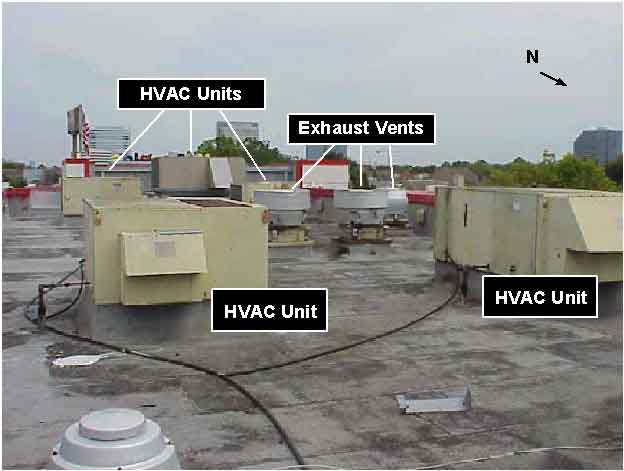
It is estimated that roughly 30% of leaks from commercial buildings originate from HVAC equipment, while only 20% of those leaks are actually roof related.
 Photo cited from – www.cdc.gov/niosh/fire/reports/face200013.html
Common leak spots for HVAC units
Holes and loose edges on HVAC fresh air intake hoods
Holes and poor weather stripping in HVAC air intake panels.
Loose or missing filter access panels on HVAC units.
Poorly designed filter access covers on HVAC ductwork.
Improperly sealed joints, seams and holes on HVAC ducts
The Roof is a Working Platform
For most construction trade – electrical, mechanical, plumbing, etc.
And many times the equipment itself is not waterproof. This often leads to roof leaks. Tenants incorrectly assume that all wet ceiling tiles mean roof leaks, but in reality it is often the rooftop equipment. So guess who gets the blame? Of course the roofer is called, while the mechanical, plumbing, and electrical contractors remain unaware of the equipment problems.
Other Common Causes for Commercial Building Leaks
25% – Skylight Louvers
15% – Windows
10% – Concrete Wall Cracks
Related Articles – Roof Leaks – Major Concern for Business
Tags:
commercial buildings,
roof leaks,
rooftop equipment
May 27th, 2011 at 11:56 am
“Greening of Low Slope Roofing Systems”
For new and existing buildings
Learn:
- What “green” means
How green roof systems work, and how much they cost
Design and construction issues and constraints
About International Construction Construction Code – 2012
Incentive programs
Evaluate the benefits, but also the potential for failure
Determine when these systems are right for your facilities
Topics:
- Advantages and disadvantages of “green” roof technology
Special design requirements for new construction and existing buildings
Codes governing design and installation
Special installation requirements
Warranty issues
LEED, Green Globe, other recognition programs
Who Should Attend this Event?
- Building Owners
Architects
Engineers
Designers
Roofing Contractors
The event is approved by the U.S. Green Building Council (USGBC)
For additional details on the event: Low-Slope Flat Roofing Event
Tags:
roofing event
 Comments Off on Low Slope Roofing Event – Photovoltaic, Reflective and Vegetative Systems
 -
May 4th, 2011 at 10:50 am
The most common roof decks used on flat roofs are steel roof decks. They are made out of cold-rolled sheets. Cold rolled refers to when steel is shaped into the decking or roof panels at room temperature. There are ribs in each panel that make them strong and rigid.
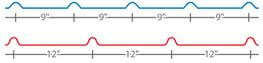

Ribs are referring to the grooves in steel panels that make them strong.
The panels come in many thicknesses, sizes, and spacing of ribs.
Many roof decks are used on flat roofs, but steel roof decks are the most popular choice in the industry today.
Other Roof Decks Installed on Flat Low-Slope Roof Systems
Cement Wood Fiber Roof Decks made from wood fibers. These are bonded together with cement and other binders. Then they are pressed together and molded into panels.
Gypsum Concrete Roof Decks made of gypsum material mixed with fillers.
Structural Concrete Roof Decks either poured on site or made into planks and then set in place.
Many types of wood roof decks exist as well, such as wood plank, plywood, and oriented strand board.
Insulating Concretes – light weight insulating concretes can be used as fills or toppings. Insulating concretes can be poured over another surface like corrugated steel or form boards.
Tags:
roof decks
Comments Off on Low-Slope Flat Roof Decks -